
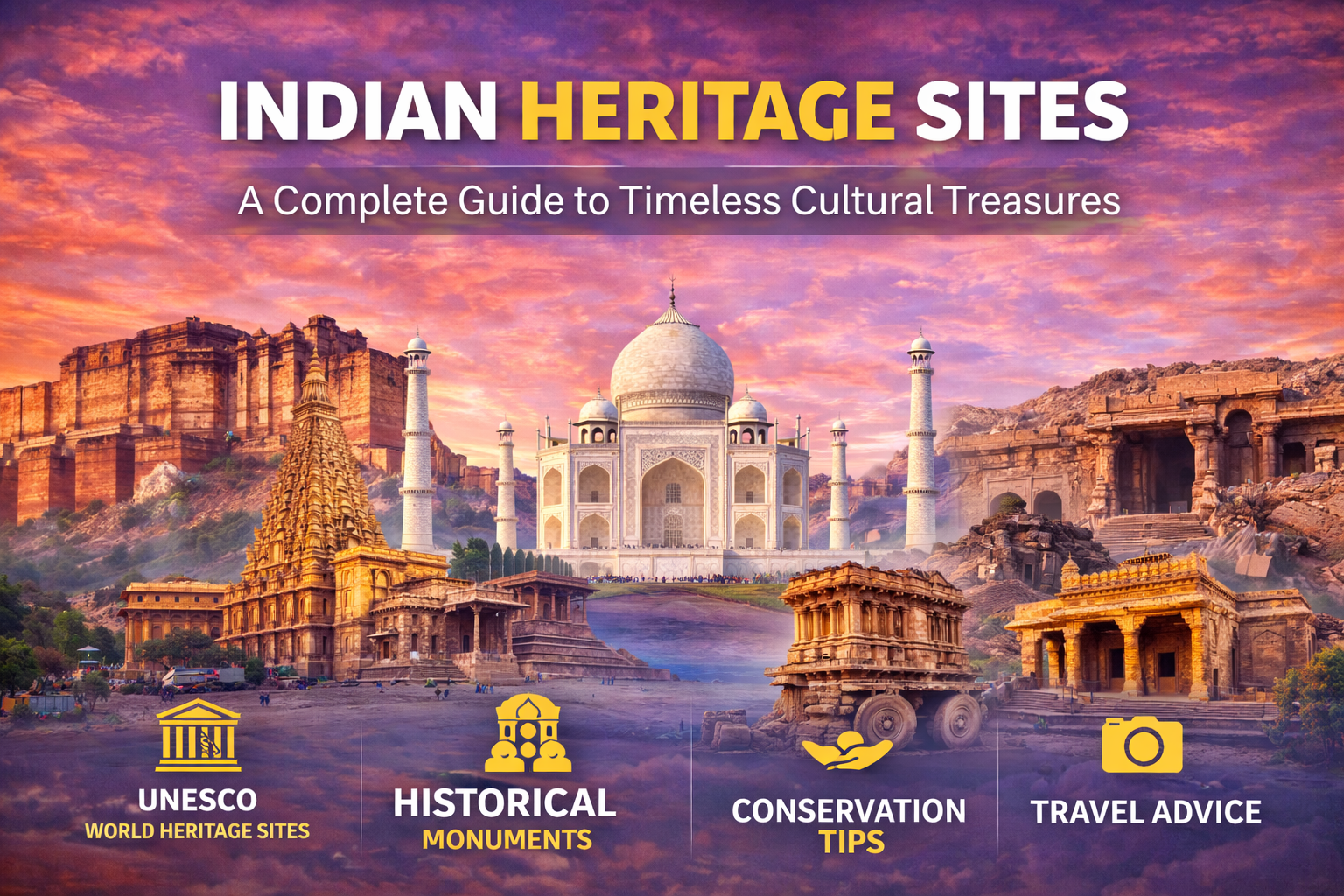
India is not just a country—it is a living museum of civilizations. From ancient cave temples carved into rock to majestic forts, sacred cities, and colonial-era landmarks, Indian heritage sites tell stories that span over 5,000 years of history.
In this Indian Heritage Sites guide (2026), you’ll discover India’s most important cultural, historical, architectural, and UNESCO World Heritage Sites, along with travel tips, best times to visit, and FAQs to help you plan a meaningful heritage journey.
What Are Heritage Sites?
Heritage sites are places of historical, cultural, architectural, or archaeological importance preserved for future generations. In India, these sites reflect:
- Ancient civilizations
- Religious traditions
- Royal dynasties
- Colonial influence
- Artistic and architectural excellence
India is home to 40+ UNESCO World Heritage Sites, making it one of the richest heritage countries in the world.
🔗 UNESCO India Heritage List: https://whc.unesco.org/en/statesparties/in
Why Indian Heritage Sites Are Globally Important
India’s heritage sites are unique because they:
- Represent multiple religions (Hinduism, Buddhism, Jainism, Islam, Christianity)
- Showcase diverse architectural styles
- Are still actively used (temples, mosques, ghats)
- Blend history with living traditions
From the Indus Valley Civilization to Mughal grandeur and British-era monuments, India’s heritage is continuous, not frozen in time.
Categories of Indian Heritage Sites
Indian heritage sites can be broadly divided into:
- Ancient Civilizations & Archaeological Sites
- Religious & Spiritual Heritage
- Forts, Palaces & Royal Architecture
- Colonial & Modern Heritage
- UNESCO World Heritage Sites
- Intangible Cultural Heritage
Ancient & Archaeological Heritage Sites in India
1. Mohenjo-daro & Harappa (Indus Valley Civilization)
Dating back to 2500 BCE, these sites represent one of the world’s earliest urban civilizations.
Why it matters:
- Advanced drainage systems
- Grid-based city planning
- Evidence of trade and governance
🔗 Archaeological Survey of India (ASI): https://asi.nic.in
2. Sanchi Stupa (Madhya Pradesh)
One of the oldest stone structures in India, built by Emperor Ashoka.
Highlights:
- Buddhist symbolism
- Intricately carved gateways
- Peaceful spiritual atmosphere
3. Dholavira (Gujarat)
A recently recognized UNESCO site showcasing the engineering brilliance of the Harappans.
Religious & Spiritual Heritage Sites of India
1. Varanasi (Uttar Pradesh)
One of the oldest continuously inhabited cities in the world.
Why Varanasi is sacred:
- Ghats along the Ganges
- Kashi Vishwanath Temple
- Spiritual rituals and Ganga Aarti
2. Bodh Gaya (Bihar)
The place where Lord Buddha attained enlightenment.
- Mahabodhi Temple (UNESCO Site)
- Major pilgrimage for Buddhists worldwide
🔗 https://whc.unesco.org/en/list/1056
3. Rameswaram (Tamil Nadu)
One of the Char Dham pilgrimage sites, famous for its long temple corridors.
4. Golden Temple (Punjab)
The spiritual center of Sikhism, known for:
- Equality and community service
- World’s largest free kitchen (Langar)
Forts, Palaces & Royal Heritage of India
1. Red Fort (Delhi)
A symbol of India’s Mughal legacy and independence.
- Built by Shah Jahan
- UNESCO World Heritage Site
🔗 https://whc.unesco.org/en/list/231
2. Amer Fort (Rajasthan)
A stunning blend of Rajput and Mughal architecture.
- Sheesh Mahal
- Hilltop views
- Part of the Hill Forts of Rajasthan (UNESCO)
3. Mysore Palace (Karnataka)
One of India’s most visited monuments, especially during Dussehra celebrations.
4. Mehrangarh Fort (Jodhpur)
A massive fort rising above the Blue City, showcasing royal arms, palaces, and museums.
Iconic UNESCO World Heritage Sites in India
1. Taj Mahal (Agra)
A global symbol of love and architectural perfection.
- Built by Shah Jahan
- White marble masterpiece
- One of the New Seven Wonders of the World
🔗 https://whc.unesco.org/en/list/252
2. Khajuraho Group of Monuments
Famous for intricately carved temples depicting life, art, and spirituality.
3. Ajanta & Ellora Caves (Maharashtra)
Rock-cut cave complexes representing:
- Buddhism (Ajanta)
- Hinduism & Jainism (Ellora)
4. Hampi (Karnataka)
The ruins of the Vijayanagara Empire, spread across a surreal boulder landscape.
Colonial-Era Heritage Sites in India
1. Victoria Memorial (Kolkata)
A reminder of British colonial architecture and influence.
2. Gateway of India (Mumbai)
Built during British rule, now an iconic symbol of Mumbai.
3. Chhatrapati Shivaji Maharaj Terminus
A UNESCO site combining Victorian Gothic and Indian architecture.
Intangible Cultural Heritage of India
India’s heritage is not just monuments—it’s living traditions.
Recognized by UNESCO:
- Yoga
- Kumbh Mela
- Classical dances (Bharatanatyam, Kathakali)
- Traditional crafts and music
Best Time to Visit Indian Heritage Sites
| Season | Months | Why |
|---|---|---|
| Winter | Oct–Feb | Best weather for sightseeing |
| Summer | Mar–May | Visit hill & indoor sites |
| Monsoon | Jun–Sep | Fewer crowds, lush scenery |
Tips for Visiting Heritage Sites in India
- Hire ASI-approved guides
- Respect dress codes at religious sites
- Avoid touching ancient carvings
- Visit early morning for fewer crowds
- Support local artisans
Responsible Heritage Tourism
- Do not litter or damage monuments
- Avoid graffiti or vandalism
- Respect photography rules
- Promote local heritage conservation
Future of Indian Heritage Tourism (2026 & Beyond)
India is investing in:
- Heritage circuits
- Digital museums
- Restoration projects
- Sustainable tourism
With better infrastructure and awareness, heritage tourism in India is expected to grow rapidly.
Frequently Asked Questions (FAQs)
1. How many UNESCO World Heritage Sites are there in India (2026)?
India has 40+ UNESCO World Heritage Sites, including cultural, natural, and mixed sites.
2. Which is the oldest heritage site in India?
The Indus Valley Civilization sites like Dholavira and Harappa are among the oldest.
3. What is the most visited heritage site in India?
The Taj Mahal is the most visited heritage monument in India.
4. Are Indian heritage sites safe for tourists?
Yes, most heritage sites are safe and well-managed, especially major UNESCO locations.
5. Can solo travelers explore heritage sites in India?
Absolutely. Cities like Delhi, Jaipur, Agra, Hampi, and Varanasi are popular with solo travelers.
6. Is photography allowed at heritage sites?
Photography is generally allowed, but some interiors and temples restrict it.
7. What is ASI?
The Archaeological Survey of India (ASI) protects and maintains heritage monuments.
8. Are heritage sites suitable for children?
Yes, many sites have museums and guided tours that are educational for kids.
9. Which state has the most heritage sites?
Rajasthan, Maharashtra, Tamil Nadu, and Karnataka have the highest number of major heritage sites.
10. How can tourists help preserve heritage sites?
By following rules, avoiding damage, supporting local communities, and spreading awareness.
Final Thoughts
Indian heritage sites are more than tourist attractions—they are stories carved in stone, faith, art, and memory. Exploring them is not just travel; it’s a journey through time, identity, and civilization.
In 2026 and beyond, responsible heritage tourism can ensure that India’s timeless treasures remain alive for future generations.